Beyond the Battlefield: How Regional Conflict Is Reshaping the Gulf’s Restaurant Industry
From disrupted supply chains and rising operating costs to changing consumer behaviour and shrinking margins, the Middle East’s food and beverage industry is confronting a new reality — one in which resilience may matter more than expansion.
For years, the Gulf’s restaurant industry has been defined by extraordinary ambition. Record-breaking openings, billion-dollar hospitality developments, international franchise expansions and an increasingly sophisticated dining culture have transformed the region into one of the world’s most closely watched food and beverage markets.
From Dubai’s luxury dining destinations to Riyadh’s rapidly expanding restaurant scene, the Gulf has built a reputation as a place where culinary concepts can scale quickly, consumer expectations remain exceptionally high and investment appetite appears almost limitless.
But beneath the polished dining rooms, ambitious expansion plans and carefully curated hospitality experiences, a different story is emerging.
Regional conflict, geopolitical uncertainty and disruptions to international trade have introduced a new set of pressures into an industry already navigating rising costs, intense competition and increasingly demanding consumers.
The consequences are not necessarily visible on every restaurant floor. Dining rooms continue to fill, new concepts continue to launch and international operators remain interested in the region.
Yet behind the scenes, restaurant businesses are being forced to reconsider some of the fundamental assumptions on which their growth strategies were built.
The question is no longer simply how quickly the Gulf’s restaurant industry can grow. It is how effectively that growth can withstand an increasingly unpredictable operating environment.
A Hospitality Powerhouse Meets Geopolitical Reality
The Gulf Cooperation Council has spent much of the past decade positioning itself as a global centre for tourism, entertainment, lifestyle and hospitality.
Saudi Arabia’s economic transformation has encouraged significant investment in restaurants and leisure destinations. The United Arab Emirates has continued to attract international hospitality groups, independent restaurateurs and ambitious homegrown brands.
Elsewhere, Qatar, Kuwait, Bahrain and Oman have developed increasingly competitive dining markets, supported by a combination of local spending, international tourism and changing consumer preferences.
The restaurant industry has consequently become much more than a collection of food businesses. It is an important component of the region’s broader economic diversification agenda.
That connection, however, also exposes the sector to developments beyond its immediate control.
Military escalation, disrupted shipping routes, changes in travel sentiment and uncertainty surrounding regional security can affect restaurants through several channels simultaneously.
Imported ingredients may become more expensive. Deliveries may take longer. International visitors may reconsider travel plans. Investors may become more selective. Consumers may reassess discretionary spending.
Even when restaurants remain fully operational, the economics of operating them can change substantially.
And unlike many other industries, restaurants have limited room to absorb prolonged financial pressure.
They must purchase ingredients continuously, employ substantial numbers of people, maintain physical premises and deliver a consistent customer experience regardless of external circumstances.
A restaurant cannot simply suspend its operating costs while waiting for geopolitical conditions to improve.
The Hidden Cost of Conflict: What Happens Before Food Reaches the Kitchen
One of the most significant vulnerabilities facing Gulf restaurants lies in their dependence on complex international supply chains.
Across the region, restaurants rely on imported meat, seafood, dairy products, specialty ingredients, packaging materials, kitchen equipment and countless other essential supplies.
This dependence is particularly pronounced among premium restaurants, international franchises and concepts built around highly specific ingredients or preparation standards.
When geopolitical tensions disrupt established shipping routes, the consequences extend far beyond the transportation industry.
Alternative routes may require additional time, fuel and handling. Insurance costs may increase. Importers may face uncertainty over delivery schedules, while suppliers may adjust their prices to reflect greater operational risk.
For restaurants, these disruptions can quickly become a financial problem.
A delayed shipment of specialist cheese or imported seafood may seem relatively insignificant compared with the broader consequences of regional conflict.
But for a restaurant whose menu, pricing and customer expectations depend on those ingredients, even a temporary interruption can create operational difficulties.
Some businesses may need to source substitutes at higher prices. Others may reduce menu availability, carry additional inventory or absorb costs they cannot immediately pass on to customers.
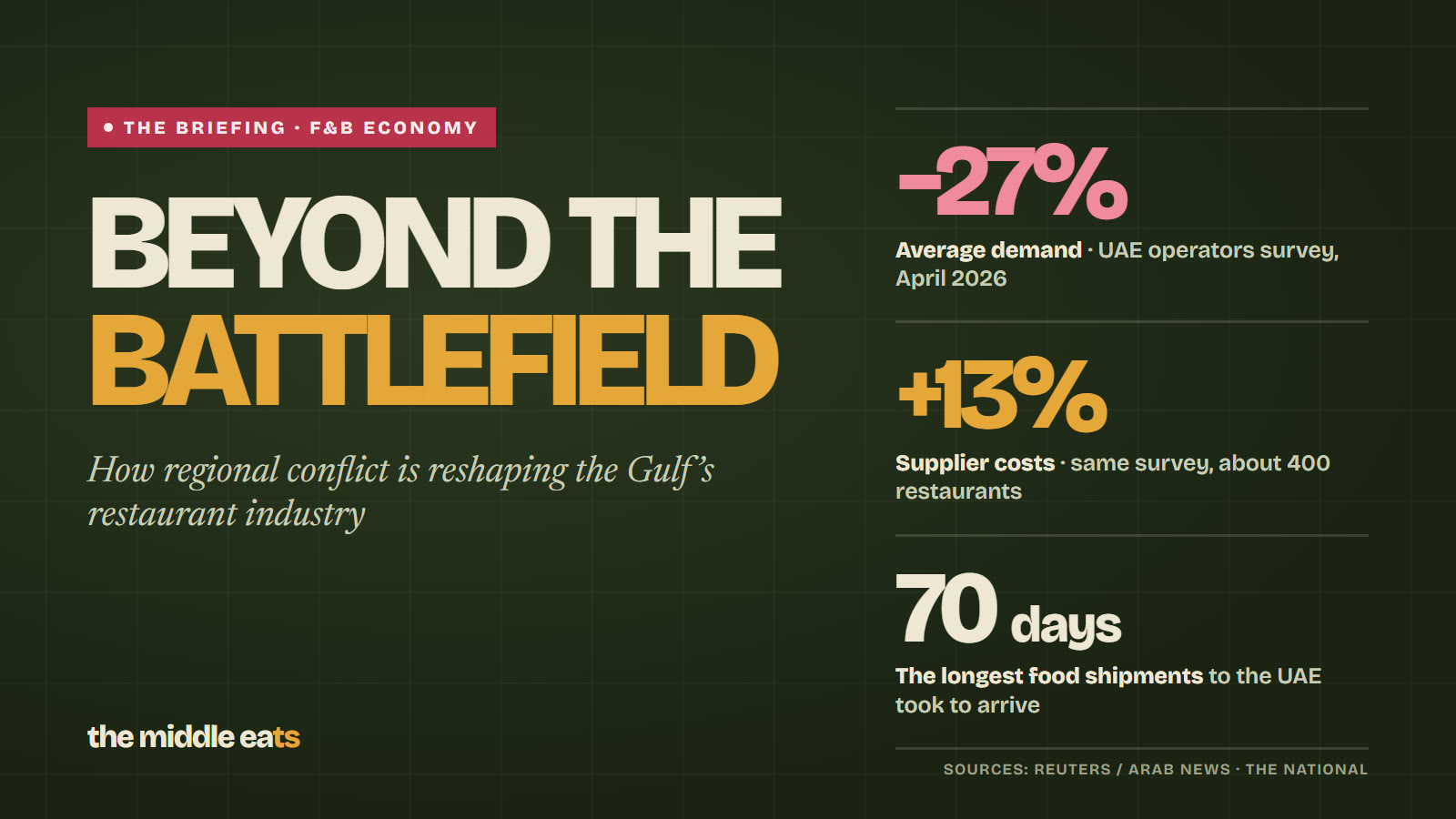
In October 2026, reporting by The National highlighted how food retailers and producers in the UAE had adapted their supply networks in response to disruptions associated with the Iran war. Some shipments were reported to have taken as long as 70 days to arrive.
The significance for restaurants is clear: supply-chain resilience is no longer merely a procurement consideration. It is becoming a strategic business requirement.
For an industry built around freshness, consistency and timing, uncertainty in the movement of goods can be especially costly.
The Margin Squeeze: When Revenue and Costs Move in Opposite Directions
Perhaps the most revealing evidence of the pressure facing restaurants emerged earlier this year.
A Reuters report published in May 2026, drawing on an industry survey of operators representing approximately 400 restaurants in the UAE, described a difficult operating environment during April.
The survey indicated an average decline in demand of 27%, alongside an average increase of 13% in supplier costs.
These figures represented the surveyed businesses during that period, rather than the entire Gulf restaurant market. Nevertheless, they illustrated a particularly dangerous combination for hospitality operators: weakening demand occurring at the same time as rising input costs.
For restaurants, this combination can be far more damaging than either challenge in isolation.
A business experiencing higher ingredient prices may attempt to protect its margins through menu adjustments, improved purchasing or operational efficiencies.
A restaurant facing weaker demand may respond through marketing, promotions or changes in staffing and operating hours.
But when both pressures arrive together, the available options become considerably narrower.
Raising prices risks discouraging already cautious customers. Aggressive discounting may increase transaction volumes without improving profitability. Reducing portion sizes or compromising ingredient quality can damage a brand’s reputation.
Meanwhile, rent, salaries, utilities, maintenance and other fixed expenses continue.
The result is a difficult commercial equation in which restaurants can remain visibly busy while becoming financially less sustainable.
This distinction matters.
A full dining room does not necessarily indicate a healthy restaurant business.
Revenue, transaction volume, gross margin and actual profitability tell very different stories.
And in a market where appearance and customer experience play such important roles, financial pressure may remain largely invisible until a business is forced to reduce operations, delay expansion or close.
Dubai: A Global Dining Capital Exposed to Global Uncertainty
Dubai occupies a distinctive position within the Gulf’s hospitality landscape.
Its restaurant economy benefits from a combination of residents, international tourists, business travellers, luxury consumers and a highly diverse expatriate population.
This international exposure has been central to the emirate’s success.
It has also made the restaurant sector sensitive to changes in global travel patterns, international consumer confidence and perceptions of regional stability.
When geopolitical tensions rise, the impact on hospitality is not necessarily immediate or uniform.
A neighbourhood restaurant serving a predominantly residential customer base may experience very different conditions from a fine-dining establishment heavily dependent on international visitors.
Likewise, a delivery-focused business may be less exposed to fluctuations in tourist footfall than a restaurant operating within a luxury hotel or major visitor destination.
The challenge for Dubai’s restaurant operators is therefore not simply the possibility of reduced spending.
It is the unpredictability of where, when and how that spending may change.
Businesses dependent on high-spending visitors may need to diversify their customer base. Premium concepts may have to demonstrate stronger value. Operators with multiple locations may reconsider the balance between destination venues and neighbourhood formats.
None of this means Dubai’s dining economy has stopped growing.
Indeed, October reporting has pointed to continued expansion in the UAE’s non-oil economy despite the conflict.
But macroeconomic resilience does not automatically translate into equal resilience across every restaurant category.
The performance of a national economy and the financial health of an individual restaurant can move in very different directions.
Saudi Arabia: Can Expansion Continue Under Pressure?
Saudi Arabia presents a different, but equally important, set of questions.
The Kingdom has become one of the most closely watched hospitality investment markets in the world.
A growing restaurant culture, major entertainment developments, changing consumer lifestyles and ambitious economic diversification programmes have encouraged both domestic and international brands to expand.
For restaurant groups, the attraction is substantial.
But rapid expansion also creates exposure.
New restaurants require considerable upfront investment. Premium locations can carry significant occupancy costs. Large-scale rollouts depend on reliable supply chains, consistent consumer demand and access to capital.
In periods of uncertainty, these assumptions deserve closer scrutiny.
The challenge is particularly relevant to businesses pursuing aggressive multi-location expansion strategies.
Opening additional branches may increase brand visibility and market share, but it can also multiply fixed costs before individual locations have established sustainable profitability.
This creates a strategic tension between capturing market opportunities and preserving financial flexibility.
The Saudi market has shown broader economic resilience, and there is no basis for assuming that geopolitical disruption has affected every restaurant operator in the same way.
Nevertheless, investors and management teams may increasingly focus on the quality of growth rather than the number of openings alone.
Site economics, customer retention, cash generation and operational efficiency could become more important measures of success.
In other words, expansion may remain attractive — but expansion without financial discipline is becoming harder to justify.
The Consumer Confidence Factor
Not every consequence of regional instability appears on a supplier invoice.
Some of the most important effects emerge through consumer behaviour.
Restaurants depend heavily on discretionary spending, particularly in premium dining, casual entertainment and experience-led hospitality.
When households become concerned about economic uncertainty, travel disruption or future expenses, they may become more selective about where and how often they dine out.
This does not necessarily mean consumers stop visiting restaurants.
Instead, spending can shift between categories.
Customers may trade down from premium dining to more affordable alternatives. Families may reduce the frequency of expensive outings. Delivery and takeaway may become more attractive for certain occasions.
Consumers may also place greater emphasis on perceived value.
These are potential behavioural responses rather than confirmed uniform trends across the Gulf in October 2026. Their significance lies in how quickly they can alter the economics of individual restaurant concepts.
For operators, the challenge is understanding whether changes in demand are temporary reactions to uncertainty or evidence of more lasting shifts in customer preferences.
The answer can determine everything from menu pricing to location strategy.
The New Competitive Divide: Scale Versus Flexibility
Periods of disruption often reveal differences between businesses that appear similar under normal market conditions.
Large restaurant groups may benefit from stronger purchasing power, diversified revenue streams, established supplier relationships and greater access to financing.
They may be better positioned to negotiate contracts, absorb short-term cost increases and redistribute resources across multiple locations.
Independent restaurants, by contrast, often operate with fewer financial reserves and less negotiating leverage.
A sharp increase in ingredient costs or an unexpected decline in revenue can therefore have a disproportionate effect on smaller operators.
But size is not an automatic guarantee of resilience.
Large groups also carry substantial overheads, organisational complexity and significant financial commitments.
Independent restaurants may have advantages of their own: faster decision-making, closer customer relationships, more adaptable menus and greater freedom to change operating models.
The emerging competitive divide may therefore be less about large businesses versus small businesses, and more about adaptable businesses versus inflexible ones.
Those capable of responding quickly to changes in supply, demand and cost structures may be better positioned to navigate uncertainty.
Why Local Sourcing Is Becoming a Strategic Advantage
One potential consequence of supply-chain disruption is a renewed emphasis on local and regional sourcing.
For years, imported ingredients have played a central role in the positioning of many Gulf restaurants, particularly within premium and internationally inspired concepts.
But dependence on distant suppliers can introduce vulnerabilities that become more apparent during geopolitical disruption.
Local sourcing can potentially reduce exposure to certain shipping delays, currency fluctuations and international logistics costs.
It may also allow restaurants to develop closer relationships with producers and respond more quickly to changes in demand.
However, local sourcing is not a universal solution.
Regional production capacity varies considerably by ingredient and market. Certain products may remain difficult or uneconomical to obtain locally, while domestic suppliers can themselves depend on imported feed, equipment, packaging or other inputs.
The strategic opportunity is therefore not necessarily to replace imported ingredients entirely.
It is to develop a more diversified and resilient procurement model.
For restaurant operators, the ability to maintain product quality while reducing dependence on a single supplier, country or shipping route may become an increasingly valuable competitive advantage.
Expansion at Any Cost Is Losing Its Appeal
One of the most consequential questions facing the Gulf restaurant industry concerns the future of aggressive expansion.
The region has become accustomed to ambitious growth announcements: dozens of new branches, international market entries and rapidly scaling food concepts.
Such expansion can create genuine economic value when supported by strong customer demand and sustainable unit economics.
But growth can also conceal underlying weaknesses.
A restaurant group may increase its total revenue by opening new locations even while profitability at existing branches deteriorates.
High construction costs, rising rents, operational inefficiencies and expensive customer acquisition can place pressure on cash flow long before those weaknesses become visible in headline sales figures.
Geopolitical uncertainty adds another layer of complexity.
Investors may become more cautious about capital commitments. Operators may require stronger evidence of location-level profitability. Franchise partners may reassess the pace of development.
This does not imply that the Gulf’s restaurant expansion cycle is ending.
Rather, it suggests that the criteria used to evaluate expansion may need to evolve.
The most compelling growth stories may increasingly be those supported by sustainable margins, repeat customers, disciplined capital expenditure and resilient operating models.
The future of restaurant investment may depend less on how many locations a brand can open — and more on how many it can operate profitably.
Technology, Data and the Economics of Survival
As pressure on restaurant economics increases, technology may become more important to operational resilience.
Accurate inventory forecasting can help reduce waste and unnecessary purchasing.
Better sales analytics can reveal changes in consumer behaviour before they become obvious in monthly financial statements.
Menu engineering can identify products that generate strong revenue but insufficient contribution margin.
Labour scheduling systems can help operators match staffing levels more closely to demand.
These capabilities are not new.
What is changing is their strategic importance.
In a relatively predictable market, operational inefficiencies can sometimes be concealed by rapid revenue growth.
In a more challenging environment, those same inefficiencies become harder to ignore.
Technology alone cannot resolve geopolitical uncertainty, eliminate rising costs or create consumer demand.
But better information can help management teams make decisions more quickly and with greater precision.
For an industry in which margins can be highly sensitive to small changes in costs and volumes, that capability matters.
Not a Collapse — But a Structural Warning
It would be misleading to portray the Gulf restaurant industry as being in uniform decline.
The region continues to benefit from substantial investment, population growth in key markets, tourism infrastructure and strong long-term ambitions for hospitality and entertainment.
Recent economic indicators have also demonstrated resilience in the UAE and Saudi Arabia despite regional conflict.
Yet resilience at the macroeconomic level should not obscure the pressures facing individual operators.
A market can continue attracting new investment while existing restaurants struggle with profitability.
New brands can enter while weaker concepts exit.
Consumer spending can remain substantial while shifting away from particular price points, formats or locations.
These developments can coexist.
That is why the most important question is not whether the Gulf restaurant industry is growing or shrinking in aggregate.
It is whether its underlying business models are becoming stronger or more vulnerable.
The answer is likely to differ substantially across countries, cities, dining categories and individual brands.
The Road Ahead: Resilience as the New Definition of Success
The Gulf’s restaurant industry is entering a period in which adaptability may become as valuable as ambition.
Geopolitical uncertainty has exposed vulnerabilities that extend well beyond the immediate consequences of conflict.
Supply-chain dependence, rising operating costs, unpredictable consumer behaviour and the financial demands of rapid expansion are forcing businesses to reconsider how they define sustainable growth.
For some operators, the response will involve stronger procurement networks and more diversified suppliers.
For others, it will require changes to menus, pricing, restaurant formats or expansion strategies.
Investors may place greater emphasis on profitability and cash generation. Consumers may become more selective. Restaurant groups may increasingly prioritise operational discipline over headline growth.
But the region’s fundamental hospitality ambitions remain significant.
The Gulf has spent years building an increasingly influential position in the global food and beverage industry.
The challenge now is to protect that position in an environment where commercial success depends on factors extending far beyond the dining room.
And perhaps that is the most important lesson emerging from the current period of uncertainty.
The Gulf’s next generation of restaurant success stories may not be defined by the brands that expand the fastest, command the highest prices or generate the loudest headlines.
They may be defined by the businesses that can continue delivering quality, value and profitability when the world around them becomes unpredictable.
Because in an industry built on serving people, the ability to adapt may ultimately prove more valuable than the ability to expand.
Editorial note: This article combines reported industry developments with analysis of potential commercial implications. The April UAE survey figures should not be interpreted as Gulf-wide October statistics. Country-level outcomes, consumer responses and future industry developments remain subject to uncertainty.
Sources & fact-check4
- Pain on the Menu as Iran War Squeezes Dubai’s RestaurantsReuters / Arab News, 1 May 2026
- We Made Our Own Supply Chain: How UAE Food Retailers and Producers Adapted to Absorb Impact of Iran WarThe National, 9 October 2026
- Non-Oil Sectors in UAE and Saudi Arabia Maintain Strong Growth Trajectory Despite Iran WarThe National, 5 October 2026
- Strait of Hormuz Tensions Strain Gulf Food Supply ChainsThe Fourth Plate, 27 September 2026
Every name, number and date in this story was checked against the sources above before publication. Spotted something wrong? Tell us — we correct errors openly. See our editorial standards.